Important Status Update
Talking Toxins is now available in archive format only
Through 12/31, you may purchase archive access to Modules 1 & 2 of Talking Toxins and get access to all course materials and handouts. All content is fully downloadable for you to keep. No future updates, edits, or additions will be made.

Foundations of Environmental Health + Everyday Exposures
Framing Toxic Exposure Through Science, Systems, and Public Health and Exploring Everyday Exposures in the Kitchen
Framing Toxic Exposure Through Science, Systems, and Everyday Contexts
Environmental chemical exposures are a major driver of chronic disease, yet most health professionals aren’t trained to recognize them.
From microplastics to “forever chemicals,” we’re all exposed to a complex, ever-changing mix of environmental pollutants. Decades of research, and a growing body of emerging science, show that these exposures contribute to a wide range of health conditions and represent a major public health concern.
And yet, many health professionals lack the training to recognize where and how these exposures show up in their clients’ daily lives, or how to talk about them in a grounded, accessible way.
At the same time, the wellness space is flooded with misinformation, fear-based messaging, and black-and-white thinking about “toxins,” leaving both practitioners and clients confused about what’s real, what’s relevant, and what to actually do.
This module, part of the larger Talking Toxins course, gives you the foundation, context, and clarity you need to speak credibly and compassionately about environmental health, starting with what it actually is!
From microplastics to “forever chemicals,” we’re all exposed to a complex mix of environmental pollutants that research increasingly links to hormone disruption, immune dysfunction, and chronic illness. Yet few practitioners receive training on how to identify these exposures, interpret the science, or communicate about them with confidence.
At the same time, the wellness space is flooded with misinformation and oversimplified advice about “toxins” — leaving both practitioners and clients confused about what’s real, what’s relevant, and what’s actually actionable.
Module 1: Foundations of Environmental Health
establishes the scientific, regulatory, and public health context for understanding environmental exposures. You’ll learn how toxicology, exposure science, and chemical policy intersect — and gain a grounded framework for evaluating risk, evidence, and credibility in this complex field.
Module 2: From Plastics to PFAS
builds on that foundation by focusing on one of the most common real-world sources of chemical exposure: the kitchen. You’ll explore plastics, PFAS, and food-contact materials, understand their links to health effects, and learn how to help clients make realistic, affordable changes without fear-based messaging.
Together, these modules give you the clarity, context, and evidence you need to speak credibly and compassionately about environmental health — starting with what it actually means, and how it shows up in daily life.
Why seeing the bigger picture — and applying it in daily life — is essential
Poor health doesn’t develop in a vacuum. To address chronic illness, we need to think beyond individual habits and consider the broader systems that shape exposure — from where we live and work, to what we eat, cook with, and store our food in.
Module 1 builds the foundation for this perspective by framing environmental exposures within the context of public health, behavior, and systems. You’ll learn how science evaluates evidence (and why “proof” looks different here), how dose and exposure shape toxicology risk, and how to avoid the traps of fear-based messaging and common myths in the wellness space.
Module 2 brings this understanding into one of the most tangible and actionable areas of daily life: the kitchen. You’ll learn how plastics, PFAS, and other food-contact materials contribute to chemical exposure, what the latest evidence says about their health effects, and how to help clients make confident, realistic changes without overwhelm or all-or-nothing advice.
Together, these modules help you see the big picture and translate it into meaningful, evidence-based action — equipping you to talk about environmental health in a grounded, credible, and compassionate way.


Who this module is for
- Health Coaches
- nurses
- women's health experts
- nutritionists
- Health Educators
- fitness professionals
- naturopaths
- Occupational Therapists
- Health Bloggers
- Physicians
- midwives and doulas
- healthy living consultants
A complete introduction to understanding and addressing everyday chemical exposures.
Information is only truly useful when you understand its context and how to apply it. These two modules work together to give you both the foundation and the practical tools you need: Module 1 establishes a grounded understanding of environmental health — how evidence, dose, and exposure interact, and how to talk about these topics confidently and accurately — while Module 2 brings that knowledge into the kitchen, showing you how plastics, PFAS, and food-contact materials contribute to exposure and how to help clients make realistic, meaningful changes without fear-based advice.
If you're only taking 1 module
Start Here
Module 1: Foundations of Environmental Health
Framing Toxic Exposure Through Science, Systems, and Public Health
What We Cover:
Environmental health is about more than just plastics and cosmetics.
In this 5-hour module, you’ll zoom out to understand what environmental health actually means — from its public health roots and regulatory history to why some communities bear far greater exposure than others. You’ll learn the difference between evidence and proof, get a primer on toxicology, and explore how to recognize misinformation, logical fallacies, and fear-based messaging.
Whether you’re a nurse, health coach, ND, MD, or educator, this module will help you confidently recognize and contextualize environmental exposures as part of your client or patient’s broader health picture — and communicate about them with clarity, nuance, and scientific integrity.

In This Module, You'll Learn How To:
Define environmental health through a public health lens
Go beyond surface-level conversations about “toxins” to understand how housing, occupation, air quality, infrastructure, and policy all shape health, and learn where this fits in to client conversations.
Understand how science, safety, and exposure are often misrepresented, and how to avoid misinformation
Learn why science is about evidence, not proof; how dose and exposure shape toxicology risk; and how to dismantle common myths, fear-based claims, and wellness soundbites with nuance and confidence.
Compare U.S. and EU regulatory systems (and their gaps)
Learn the history of chemical regulation in the US, the current landscape. of chemicals in commerce, and why “it’s banned in Europe” isn’t always a reliable benchmark.
Understand the role of chemical exposures in chronic disease
Explore how exposures to substances like lead, phthalates, and air pollutants are linked to cardiovascular disease, cancer, diabetes, and more, and why this matters even when clients are “doing everything right.”
Recognize the reality of disproportionate exposure
Discover how race, income, zip code, and job type affect toxic burden, and why addressing environmental health requires more than personal lifestyle changes - it requires empathy, context, and systems thinking.
Communicate clearly and credibly about toxins in your practice
Learn why precise language matters, how to avoid logical fallacies, and best practices when communicating complex science to clients so they'll actually act on it - all without fear or overwhelm.

Module 1 Outline
Framing Toxic Exposure Through Science, Systems, and Public Health
- Introduction & What To Expect
- What Is Environmental Health?
- Public Health vs Individual Health
- The Primary Drivers Of Disease
- The History of Environmental Health Policy
- How Chemicals Are Regulated Today: US vs EU
- Disproportionate Exposure & Environmental Justice
- Evidence Over Extremes: Understanding Toxicology, Risk, and Scientific Nuance
- Avoidance Over Detoxification
- Best Practices For Talking About Toxins
- Navigating Emotional Responses
This Module Includes:
11 Video Lessons
Each lesson is delivered in a narrated video format, perfect for visual learners. This module is 4 hours and 50 minutes in legnth.
Downloadable Transcripts, Audio Files, & Slides
Learn faster by reading? Skip the videos and go straight to the transcripts, download the audio to listen on the go, and save the slide decks for easy reference.
Practitioner Handouts & Resources
Get practical tools to help you speak confidently about environmental health, from language swaps and logical fallacies to global regulation comparisons and a client-ready infographic.
Student Only Facebook Group
Get access to a community of health professionals where you can ask questions about safer products, best practices for talking toxins with your clients, and more!
Access To Ongoing Office Hours
Once a month, ask Lara any accumulated questions about toxic exposures via Zoom (even long after you’ve finished the module)
2-Year Access To Course & Any Updates
Your enrollment includes 2 years of access to all course content and updates, and you get ongoing access to Lara directly through Facebook & Office Hours
Module 2: From Plastics to PFAS
Understanding and Reducing Kitchen-Based Exposures
What We Cover:
Plastics, microplastics, and PFAS are some of the most common and most concerning chemicals in our daily routines.
In this 3-hour module, you’ll explore how plastics, packaging, cookware, and even the act of cooking itself can introduce chemicals into our bodies and homes. You’ll get a deep dive into the specific phthalates used in plastics, bisphenols, PFAS, and microplastics, and break down why ceramic-coated isn’t a good choice (and when it is!). Exposure risks from the kitchen are often overstated, understated, or outright dismissed. In Module 2, you’ll learn what the evidence says and how to relay this back to your clients or patients, in an informative, balanced, and accessible way.
Whether you’re a nurse, health coach, ND, MD, or educator, this module gives you the evidence, context, and offers your clients practical strategies for reducing exposure in realistic, accessible ways.

In This Module, You'll Learn How To:
Identify key chemical families commonly found in all kitchens
Explore plastics, PFAS, phthalates, and other chemicals present in cookware, storage containers, and even the air from cooking.
Evaluate cookware and storage materials with confidence
Compare the risks and benefits of plastics, silicone, stainless steel, ceramic-coated, aluminum, and nonstick surfaces.
Offer realistic, accessible swaps for clients
Recommend safer options that fit different budgets and lifestyles, reducing exposures without fear, guilt, or perfectionism.
Understand how and when chemicals are released into foods and air
Learn how heat, acidity, fat content, and product wear influence chemical migration and exposure risk, and which appliance heavily pollutes indoor air.
Navigate the shifting regulatory landscape
Understand current and emerging state and federal rules on PFAS and food contact materials.
Communicate about kitchen exposures with clarity and sensitivity
Frame guidance in culturally respectful, empowering ways so clients can make changes that feel doable and non-judgmental.

Module 2 Outline
Understanding and Reducing Kitchen-Based Exposures
- Introduction & What To Expect
- Why Start With The Kitchen?
- Plastics and Microplastics in Food Prep
- Cookware and Coatings
- Food Packaging and Processed Foods
- Gas Stoves and Indoor Air Pollution
- Best Practices for Talking About Kitchen Exposures
This Module Includes:
7 Video Lessons
Each lesson is delivered in a narrated video format, perfect for visual learners.
Downloadable Transcripts, Audio Files, & Slides
Learn faster by reading? Skip the videos and go straight to the transcripts, download the audio to listen on the go, and save the slide decks for easy reference.
Student Only Facebook Group
Get access to a community of health professionals where you can ask questions about safer products, best practices for talking toxins with your clients, and more!
Access To Ongoing Office Hours
Once a month, ask Lara any accumulated questions about toxic exposures via Zoom (even long after you’ve finished the module)
2-Year Access To Course & Any Updates
Your enrollment includes 2 years of access to all course content and updates, and you get ongoing access to Lara directly through Facebook & Office Hours
Practitioner Handouts & Resources
Get practical tools to help you speak confidently about plastics, microplastics, and safer cookware, spot misleading marketing in cokware, and talk about gas stove concerns
In each Talking Toxins module, you'll get resources, support, and an evidence-based education
Practitioner resources
Get 19 practical downloadable resources to support your learning, including a language swap guide, conversation prompts, a logical fallacies cheat sheet, and a US vs. EU regulation snapshot – and client-facing handouts, all designed to support your learning and your client work.
Self-paced, community supported
Move through the lessons and handouts at your own pace! Whether you enroll in just one module or the full Talking Toxins course, you’ll have direct access to me in our community Facebook group, as well as our Monthly Office Hours. Ask Lara any questions and engage with other students!
Balanced education
This course delivers balanced, evidence-based education rooted in peer-reviewed research. It dismantles common myths, clarifies what the science actually says, and helps practitioners avoid sensationalism or fear-mongering, so you can speak confidently, accurately, and responsibly about environmental exposures in your work.
Practitioner resources
Get 19 practical downloadable resources to support your learning, including a language swap guide, conversation prompts, a logical fallacies cheat sheet, and a US vs. EU regulation snapshot – and client-facing handouts, all designed to support your learning and your client work.
Balanced education
This course delivers balanced, evidence-based education rooted in peer-reviewed research. It dismantles common myths, clarifies what the science actually says, and helps practitioners avoid sensationalism or fear-mongering, so you can speak confidently, accurately, and responsibly about environmental exposures in your work.
Practitioner Resources
I love a good handout! That’s why I’m including a series of 19 practical, ready-to-use resources to help you apply what you’ll learn in Module 1 & 2. These resources are designed to make complex topics easier to explain and to help you be more credible, grounded, and science-savvy when talking about toxins.

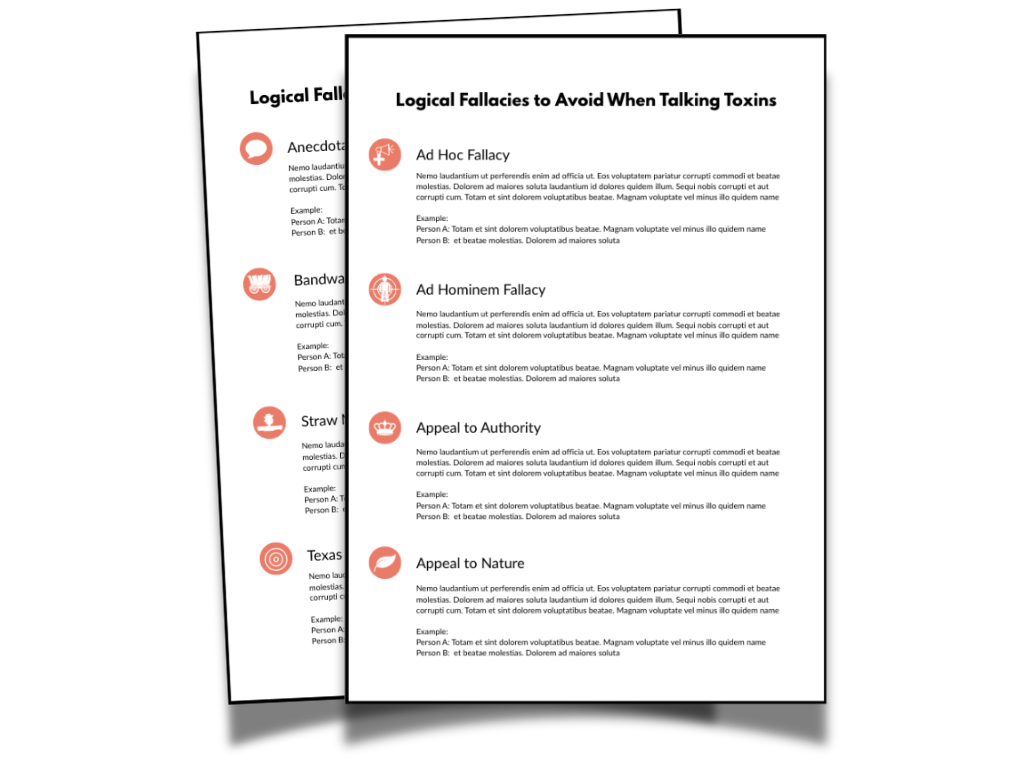
Logical Fallacies to Avoid When Talking Toxins
A quick reference guide on common reasoning traps people fall into to help you refine your communication
"What to Say Instead" Language Swap Guide
A cheat sheet of science-accurate alternatives to common phrases that oversimplify, sensationalize, or misrepresent risk
US vs. EU Chemical Regulation Snapshot
A quick reference guide outlining the fundamental differences in chemical regulations & the pros and cons of each
Conversation Prompts: Introducing Toxins To Clients
Non-judgmental scripts and openers to help you bring up exposures with ease, even with clients who are new to the topic
Gas Stove Pollution Fact Sheet
An evidence-backed overview of pollutants released from gas stoves, who is most at risk, and practical mitigation tips.
Kitchen Plastics Quick Reference
A practitioner resource on plastics in the kitchen, leaching risks, and what to do and not to do with plastics that are present.
Misleading Product Claims in Kitchenware
A review of the multiture of misleading marketing messages to quickly help you educate your clients or patients
White Labeled Handouts
What is Environmental Health, Guide to Plastics in the Kitchen, and Guide to Safer Cookware - all yours to brand yourself.






Here’s what’s included with Module 1 &2 Archive
- 2 completed modules from the 2025 rebuild (Modules 1 & 2)
- ~5 hours of lessons in Module 1 + ~3 hours of lessons in Module 2
- Full transcripts, with references, for every lesson
- Downloadable slide decks
- Practitioner resources included with each lesson
- Files are yours to download and keep
All for:
$290
Talking Toxins is retired — this archive includes the two completed 2025 modules only. No additional modules will be created or added. After purchase, you’ll receive an email with download access. Please save files locally. All sales are final.

Want the full picture? Upgrade to the complete Talking Toxins course!
Save $290, earn CE credits, and get exclusive resources you won’t find in the individual modules

Talking Toxins is a 6-module course that equips health professionals with the knowledge and tools to address the most common environmental exposures clients and patients face at home — along with practical, accessible ways to reduce them.
Across all six modules, you’ll learn to navigate this topic in a balanced, grounded, and evidence-based way, while avoiding the sensational, fear-based tone that overwhelms rather than educates.
With the full course, you'll get access to:
| Features | Individual Modules | The Full Course |
|---|---|---|
| Access to 1 Module | (All 6) | |
| Quiz, Certificate of Completion & CEU Credits | ||
| White-Labeled Handouts | ||
| Practitioner Resources | ||
| Extended Practitioner Resource Kit (reference guides, client scripts, etc) | ||
| 2 Years of Access | ||
| Monthly Office Hours with Lara | ||
| Student-only Facebook Group | ||
| Save $290 vs Buying Modules Separately |



By enrolling in the Talking Toxins course, or it's individual modules, you are agreeing to our Terms & Conditions. If, after enrolling and reviewing the course materials you feel it’s not a good fit for you, simply send me an email within 48 hours of your purchase at [email protected], explaining what didn’t work for you, and a full refund will be offered. Additionally and in plain English, these terms simply state that you must honor your investment by not sharing any files, resources, information, or log-in credentials with anyone and that all course materials are protected by copyright and therefore non-stealable! That’s pretty fair! To read the full Terms & Conditions for your purchase, click HERE.

Hi, I’m Lara Adler
I’m an Environmental Health Educator and Science Communicator with over 14 years of experience helping health professionals and health-focused businesses understand the impact of environmental chemicals on chronic health conditions. My work bridges established and emerging research with practical, accessible strategies to minimize toxic exposures and build resilience against environmental challenges.
Combining environmental health education with business consulting, I’ve helped over 5,000 health professionals in more than 35 countries elevate their expertise, achieve better client outcomes, and become sought-after leaders in the growing field of environmental health.
I’m passionate about bringing balanced, and evidence-based perspectives to the environmental health conversation, and work to push back against sensationalized, fear-mongering content that harms the overall discussion.
Frequently Asked Questions
The Talking Toxins course, and each of it’s modules, is designed for health professionals or health educators, but you do not have to be one to benefit from what you’ll learn.
Most of my students are health professionals like: health coaches, nutritionists, nurses, NDs, MDs, DOs, occupational therapists, doula/midwives, etc.. I also have a lot of health educators, content creators and bloggers in my student pool.
A small number of my students are super motivated moms, or people on their own healing journey who are seeking ways to decrease their toxic load. If this is you, you’re welcome to join!
Individual modules of the Talking Toxins course do not offer continuing education credits. However, the full Talking Toxins course (ie, all 6 modules) is approved for 10 CEU hours from:
- The National Board for Health and Wellness Coaching (CEA-000123-1)
- The National Association of Nutrition Professionals
- The Health Coach Alliance
- The Association for Integrative Nutrition
We are always seeking new CEU opportunities – if you don’t see your certifying board listed, please reach out to me at contact @ laraadler.com
Each module varies in length, but fall between 90 minutes and 3 hours. Because this course is a self-paced you can move through it on your own time. Once enrolled, you will have 2 full years to complete it.
Nope. This is education. In fact, within Module 1 there’s a lesson covering all the reasons why Talking Toxins does not include detoxification protocols.
That said, by following along in each module of the course, you’ll learn how to identify and address the common environmental exposures your clients or patients may be getting, thereby lowering their body burden. The first, most important, and most overlooked step in detoxification is actually avoidance, which is exactly what you’ll learn inside this course.
Absolutely! Each lesson in this course is fully cited. The majority of the research referenced in this course is from public health institutions, academic institutions, and well-respected, peer-reviewed journals. Open source research is prioritized to make following the paper trail equitable and accessible to all.
If you have any questions I didn’t answer here, just drop me an email at contact @ laraadler.com and I’ll get back to you ASAP!